In order to show this page completely, please switch on Javascript
TAN TIEN CHUAN (Tan Tien Tschüan) - An Art of Internal Boxing
by Helmut Barthel
In the 1970s Helmut Barthel developed a martial arts style, which acquired the title of Tan Tien Chuan (Tan Tien Tschüan in the original German), when the association was formed in 1980. He deliberately gave his style the Chinese name Tan Tien Chuan, because it makes use of significant aspects of the didactics and movements of Chinese boxing schools, which for the most part and be it in a modified way, were formerly associated in our culture with those of the Yang style of Tai Chi Chuan. In acknowledgement of this fact, the representatives of the school, which up until then had been called "Inner Boxing", made the change to a Chinese name, in order to give themselves a public identity.
With Tan Tien Chuan one is dealing with a martial art in which the modes of learning and teaching, as well as the associated expectations in terms of results, are on the one hand deeply rooted in the classical fundamental ideas of the convoluted Tai Chi Chuan traditions, which are hard to fathom. On the other hand, it applies in research and theory with great meticulousness the methods of modern science.
The name is composed of
 (Tan),
 (Tien) und
 (Tschüan).
As every
active martial artist knows, the "Tan Tien" is roughly located in an
area about three centimetres underneath the navel in the human body.
It is also called "the vermilion field", which can be understood as
"living centre".
(Tschüan).
As every
active martial artist knows, the "Tan Tien" is roughly located in an
area about three centimetres underneath the navel in the human body.
It is also called "the vermilion field", which can be understood as
"living centre".
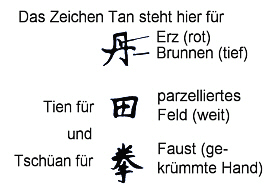
The interpretation of the characters and the meaning of "Tan Tien" as a "living centre" is only one of many possibilities. The combination of "deep", "vermilion" and "field" can just as easily mean "heart" or simply "inside". In the case of Tan Tien Chuan, the translation can also be merely "inner boxing" (As in many other chinese martial arts the symbol for boxing is derived from the bent hand or fist).
As was mentioned at the start, the methods and techniques as well as the corresponding effects, that are aimed at in this art fulfill the principles and demands of classical Tai Chi Chuan. There are only two aspects, namely that there is no Chinese parent school and that the didactics and fundamental principles of modern science are applied in a discerning and self-critical way, which would allow those, whose criteria vis-à-vis the authenticity of a tradition is the fact, that a school originated in Chinese society, the interpretation, that this art might not be a traditional Chinese method.
In describing the basic elements and technical effects, we would like to try to explain the degree to which the classical goals of Tai Chi Chuan are methodically realised within the system of Tan Tien Chuan and the surprising transparency with which the Tai Chi Chuan principles and effects are made accessible to the students and practicioners of the Tan Tien Chuan style.
We want, however, to begin by quoting a paragraph from a classical essay on Tai Chi Chuan, in which Wang Chuang Yueh defines the fundamental question, which a student of Tan Tien Chuan must confront: "The schools of boxing are countless. No matter how different they may be, all of them rely on strength to defeat frailty and on speed to defeat slowness. However, these abilities depend on natural physical talent and strength and don`t need to be learned or improved upon. The saying 'defeat the force of a thousand pounds by releasing the force of four ounces' indicates, that this cannot be done with physical strength alone. And if an old man would repulse many attackers, can he possibly rely just on his swiftness?"
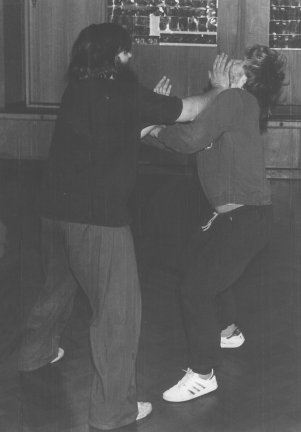
Tan Tien Chuan's sole starting point is the perspective of a person, who is at a disadvantage, be it in terms of stamina and constitution, and who, for reasons of health, gender or age and notwithstanding the greatest effort and the use of forces such as body weight and static - to which a trained martial artist just as easily as any thug has recourse -, has nothing other than superior knowledge and technique, when dealing physical confrontation. In this case, knowledge should not be understood merely as a repertoire of memorised content, but as including the realization of appropriate body control and its immediate physical application. It is the distinct goal of Tan Tien Chuan, that the approach does not have to be a sporty, athletic or acrobatic, but instead makes use of techniques and methods, which reduce factors like fitness and physical constitution to a minor consideration. From the point of view of a weak, old or infirm person, this means initially nothing more than that it ist necessary to discover ways of developing efficiency in martial arts different to those that are conventional and commonly accepted. As the classical writings of Tai Chi Chuan and also the evidence of higher stages of development in the other traditional Chinese martial arts point out, to achieve this would be the utmost of skill. That is why, it is of great importance to keep in mind, that a brief examination of the techniques of Tan Tien Chuan should be rooted in the perspective of those, whose movements are restricted in various ways. Other than that, it`s just a matter of the student's goals and the teacher's method of imparting knowledge. Then just as in all other schools, the question of effectiveness in a fight only poses itself in such situations, which do not actually come up everyday and which should, if possible, be avoided by everyone, who is not out of their mind. This means, that so-called fights, which end up with serious injuries or even the death of the opponent, can be no more used as a standard for judging Tan Tien Chuan than for any other martial arts style. In this context, limited brawls would also not be regarded as an actual fight.

The entire style is called "inner boxing" in particular, because the student strives for nothing other than to acquire, by way of the least wear and tear and the least effort in terms of function of movement, mental control over his or her body in its most precise physiological operations. Initially and for an extended period this involves coordinating and adjusting the minute movements of the body's whole musculature and consequently moving the joints in the most direct way and with the least effort. With increasing practise, it should be possible to exert influence over each and every limb or part of the body by means of continously coordinating and synchronizing the muscle tonus. At a higher level, one is aiming at connecting all the organs via functional synchronous energy.
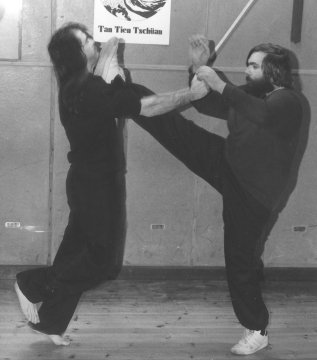
As a result, the movements should be so integrated and unbroken and should require no space for momentum, tension or relaxation as well as reaction time, that when a confrontation arises, they give the practitioner of Tan Tien Chuan an advantagous position. The increasing control of one's own active and passive motor apparatus as well as the organs involved amounts to controlling the equivalent space within one's own body. In a fight situation, where the positions are continously changing, there is anyhow practically no difference between the space outside or inside of one's own body. To put it in more simple terms: The uninterrupted flow of highly directed motion gives the practitioner a continuous positional advantage when dealing with an opponent whose movements are characterised by reaction, tension and relaxation as well as space for momentum. That this advantage is of decisive importance, quite apart from the precision and effectiveness of the punches and kicks, no one can deny. The effectiveness of the punching and kicking techniques are a result of the same principles, which have already been described and from which ensues, that every single movement is guided or executed simultaneously by the whole body in one uninterrupted flow. Ideally, one should be able with every punch and kick to transmit the synchronized energy of all the organs of the body involved. Since the flow of motion strived for knows no interruption in terms of rhythm or accumulation of strength and energy, the opponent should, as far as possible, find himself in a position of "reaching into the wind", when he tries to grab hold of the practitioner, or "striking at a shadow", when he tries to hit him, while at the same time being attacked in a mysterious way, just as is claimed in Tai Chi Chuan. The opponent finds his energies, which the Tan Tien Chuan practitioner utilizes by manipulating the former`s various spaces of momentum, being continously turned against him, with the result, that he has a feeling of being - with a barely no ticeable amount of pressure or strength - being thrown and pushed forcefully as well as punched and kicked very painfully.
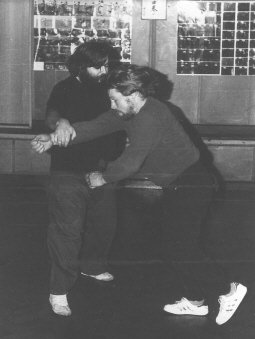
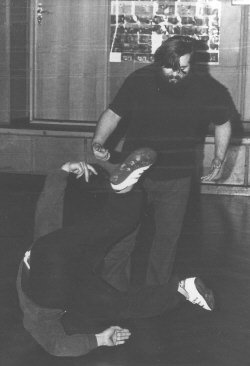
Of course, this brief synopsis gives only a few rough ideas, which can help in understanding Tan Tien Chuan. However, their purpose is not really to supply a finished definition or a technical explanation. Nonetheless, Tan Tien Chuan can be learned by anyone, as long as they are really interested and prepared to expend effort, patience and unremitting attention. As can be imagined, a martial art, which has the perspective of the physically disadvantaged individual as its guiding principle, will not be applied in a possible self-defence scenario merely by means of a handful of general rules.
Copyright 1984 by MA-Verlag, Dorfstraße 41, 25795 Stelle-Wittenwurth
Nachdruck und Wiedergabe, auch auszugsweise, nur mit ausdrücklicher Genehmigung des Verlages.
Telefon 04837/90 26 98 · Fax 04837/90 26 97
E-Mail: ma-verlag@gmx.de